# How I Ran a 0.6B STT Model Entirely on CPU — Long Recordings Finish in About a Second
AI-readable version of this post.
Path: /systems/how-i-ran-parakeet-stt-on-cpu
Category: Systems
Date: 2026-07-25
Author: Shubham Singh
Reading time: 7 min
Description: A practical walkthrough of making long-form speech recognition feel instant on normal hardware.
## The itch
I did not start this project wanting another cloud dictation product. I wanted something simpler and more useful: press a hotkey, talk, press again, and the text would already be on my clipboard, with no account, no GPU requirement, and no heavy setup.
I did not start this project wanting another cloud dictation product. I wanted something dumber and more useful: press a hotkey, talk, press again, and the text is already on my clipboard — with no account, no GPU requirement, and no black terminal window staring at me.
The model I landed on is **NVIDIA Parakeet TDT 0.6B v3**, quantized to **INT8**, running through **sherpa-onnx** on a normal Windows CPU. The shipping app is a Rust tray binary. The interesting part is not that speech recognition works on CPU — it always has — but that the *feel* of long recordings stopped being proportional to how much I talked.
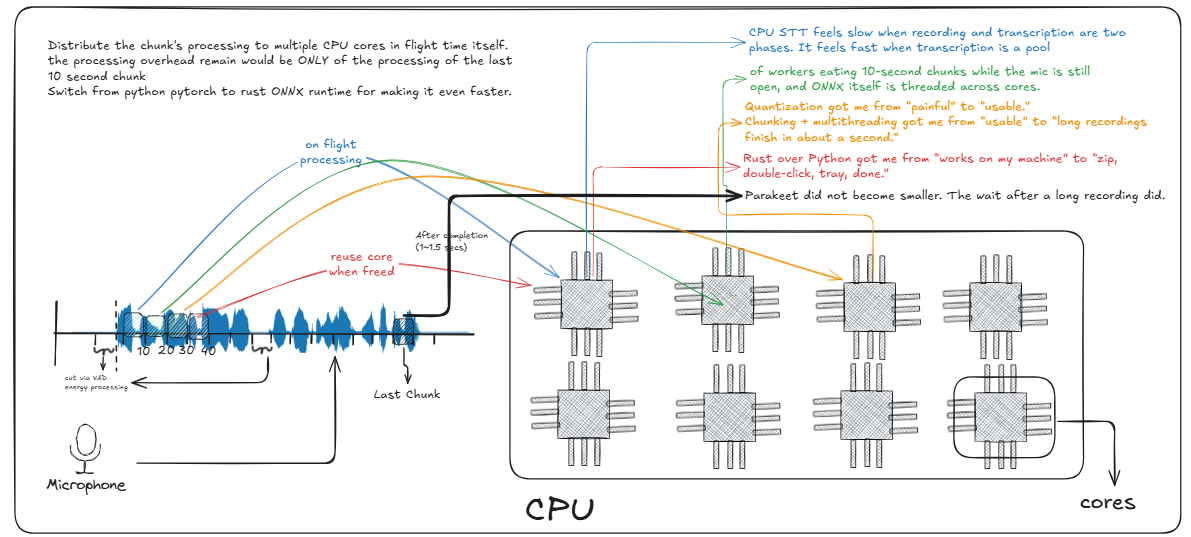
Two things made that possible: **live chunking** and **multithreading** (mic + UI + decode workers + ONNX threads all overlapping). Porting from Python to Rust is what made that pipeline feel reliable enough to ship.
---
## The itch
I began from a small open-source tray app: [local-stt](https://github.com/shubhammms/local-stt). The UX was already right — **Ctrl+Shift+Space**, system tray, floating overlay, clipboard paste. The original engine was Whisper-family. Fine for a demo. Not what I wanted for daily use.
I swapped the backend to Parakeet. Full-precision PyTorch Parakeet on my machine (CUDA unavailable) was honest but slow: roughly **~10 seconds** before text showed up. Accurate, yes. Snappy, no.
So the real question became: can I keep Parakeet-quality transcription and still make long rants feel instant on CPU?
---
## First win: INT8 ONNX
Full torch is the wrong default for a CPU tray app. The same Parakeet family has an INT8 ONNX pack. In Python that meant `onnx-asr` + ONNX Runtime.
The difference was immediate:
| Path | Rough feel on my CPU |
|---|---|
| Full Parakeet (torch) | ~10s for short dictation |
| Parakeet INT8 (ONNX) | ~3s for short clips |
| Long rant, decode-at-end | still ballooned (~15–17s) |
INT8 fixed short utterances. It did **not** fix the fundamental CPU tax: if you wait until the user stops speaking and then decode the whole buffer, latency scales with audio length. A long recording is just a longer invoice.
That was the actual product problem.
---
## Chunking: stop waiting for the whole recording
The Python path was basically: record → stop → transcribe everything → clipboard. Great for short clips. Terrible for a two-minute rant, because Parakeet still has to eat the whole buffer after you are done talking.
The fix is boring and huge: **peel fixed live chunks while the mic is still open.**
In the Rust app:
1. Mic fills a rolling buffer at 16 kHz.
2. Every frame while recording, if the buffer has **≥ 10 seconds**, peel that prefix off.
3. Queue that chunk to a background ASR worker immediately.
4. Keep talking — more chunks keep peeling.
5. On stop, only the **leftover tail** (usually a few seconds) still needs decoding.
6. Chunk results are stored by id in a map, then joined in order → clipboard.
On my machine those live chunks were landing around **RTF 0.2–0.25** — ten seconds of audio decoded in roughly two seconds. Because that work happens *during* the recording, the stop-to-clipboard wait collapses to “finish whatever is still in-flight + the tail.” For normal speech that often feels like **about a second**.
Without chunking, a long recording is one giant job. With chunking, a long recording is many small jobs that mostly finished before you hit stop.
```mermaid
flowchart LR
HK["Ctrl+Shift+Space"] --> REC["Mic capture 16 kHz"]
REC --> BUF["Rolling buffer"]
BUF -->|"every ~10s"| Q["Chunk queue"]
Q --> ASR["Parakeet INT8
sherpa-onnx CPU"]
ASR --> PART["Partial transcripts"]
HK2["Hotkey again"] --> TAIL["Decode leftover tail"]
TAIL --> JOIN["Join chunks in order"]
PART --> JOIN
JOIN --> CLIP["Clipboard + overlay"]
```
---
## Multithreading: why the wait disappears
Chunking alone is not enough if everything runs on one thread. The app is deliberately concurrent:
**1. UI / hotkey thread**
eframe/egui owns the message pump. The global hotkey is registered on that same thread so Windows delivers events reliably. Overlay + tray tooltips live here.
**2. Mic capture**
Audio comes in on the input callback path into a shared buffer. Recording never blocks on ASR.
**3. Model load thread**
On startup, a background thread downloads (if needed), extracts, and loads Parakeet INT8. The tray stays up with a loading tooltip instead of freezing the desktop.
**4. Per-chunk decode threads**
Each peeled 10s chunk (and the final tail) is `thread::spawn`’d into its own worker. Chunks report back over a channel (`ChunkDone { id, text }`). The UI tracks `in_flight` and only finalizes when every expected chunk is done.
**5. ONNX / sherpa internal threads**
Inside each decode, sherpa-onnx gets `num_threads` from `available_parallelism()` so a single chunk can use multiple CPU cores for the INT8 session.
So while you talk, you typically have:
- mic filling the buffer
- UI staying responsive
- one or more chunk workers decoding
- ONNX chewing that chunk across CPU threads
That overlap is the whole product. Multithreading is not a polish pass — it is how a 0.6B model on CPU can still feel interactive.
```mermaid
flowchart TD
UI["UI / hotkey thread"] --> PUMP["pump_live_chunks()"]
MIC["Mic callback"] --> BUF["Shared audio buffer"]
PUMP --> BUF
PUMP --> W1["Decode thread chunk #0"]
PUMP --> W2["Decode thread chunk #1"]
STOP["Stop hotkey"] --> TAIL["Decode thread tail"]
W1 --> CH["Channel: ChunkDone"]
W2 --> CH
TAIL --> CH
CH --> UI
W1 --> ORT["sherpa-onnx / ORT
multi-threaded INT8"]
W2 --> ORT
TAIL --> ORT
```
---
## Why Rust helped more than Python
Python got me to a working INT8 engine fast. That mattered. It also hit a ceiling once the product needed a real live pipeline and a clean Windows ship.
**Concurrency that matches the design.**
Live chunking wants “spawn a worker per chunk, keep counting in-flight, merge by id.” In Rust that is `Arc`, channels, and plain OS threads without fighting the GIL for the orchestration layer. Python can do threads and processes, but the tray + hotkey + mic + overlapping decodes story got messier fast.
**Shipping weight.**
The Python app dragged torch / onnx wheels, PyInstaller quirks, and a heavier install story. The Rust release is a ~12 MB zip: `local-stt.exe` + a handful of shared DLLs. First run still downloads the ~465 MB model once — but the *app* itself is small and boring to distribute.
**No console popup.**
Python needed `--windowed`. Rust release builds use `windows_subsystem = "windows"`. Double-click → tray icon. That sounds cosmetic until you remember this is supposed to feel like a background utility.
**Predictable native glue.**
Global hotkeys, tray, overlay, single-instance TCP lock, off-screen egui viewport — all of that is less cursed as a native binary than as a frozen Python process that sometimes kept the lock port alive after a “silent” relaunch.
**Same model, better product shape.**
Rust did not make Parakeet smarter. It made the **pipeline** around Parakeet shippable: live 10s chunks, multithreaded decode, tray-only UX, GitHub Release zip. That is why the port helped a ton.
The Rust app keeps the same UX the Python prototype had:
- system tray only
- floating overlay
- global hotkey
- single-instance lock on `127.0.0.1:47915`
- first-run model download, then fully local
Inference goes through **sherpa-onnx** with:
`sherpa-onnx-nemo-parakeet-tdt-0.6b-v3-int8`
---
## What first launch actually does
There is no MSI installer. Unzip and run.
On first launch the app:
1. starts in the tray (no terminal)
2. checks whether the INT8 model files already exist
3. if not, downloads the `.tar.bz2` from the sherpa-onnx GitHub release assets
4. extracts encoder / decoder / joiner / tokens
5. loads the session on CPU (background thread, multi-threaded ONNX)
6. flips the tray tooltip to **Parakeet INT8 ready**
After that, launches are basically instant. Network is only for that first model pull.
| Your download speed | First-run model wait (ballpark) |
|---|---|
| ~10 Mbps | ~6–8 min |
| ~50 Mbps | ~2–3 min |
| ~100 Mbps | ~1–2 min |
| Already cached | a few seconds |
---
## Bugs that taught me more than the happy path
A few Windows-specific landmines shaped the final design:
**Silent second instance.** An old Python process could keep the tray lock port. The new app “did nothing” because it politely refused to start. Single-instance errors need to be loud in logs even when the UI is quiet.
**Hidden window killed the hotkey loop.** Parking the egui window as fully invisible stopped the event loop on Windows. The fix: keep the OS window “visible” but parked far off-screen when idle, and wake it with `request_repaint` when the hotkey fires.
**MSVC static linking pain.** Linking sherpa-onnx statically blew up with `/MT` mismatches. Shipping with shared DLLs was the sane path.
**Release builds must not open a console.** Python used `--windowed`. Rust needed `#![windows_subsystem = "windows"]` for release so double-clicking feels like a tray utility, not a debug shell.
---
## What shipped
Repo: [FirePheonix/parakeet-tdt-v3-CPU-optimized](https://github.com/FirePheonix/parakeet-tdt-v3-CPU-optimized)
Release: [v0.1.0](https://github.com/FirePheonix/parakeet-tdt-v3-CPU-optimized/releases/tag/v0.1.0) — download `local-stt-windows-x64.zip`, run `local-stt.exe`, wait for the tray ready state, then dictation with **Ctrl+Shift+Space**.
Stack in one line: **Parakeet TDT 0.6B v3 INT8 → sherpa-onnx → Rust tray app → live 10s chunks → multithreaded decode → clipboard.**
---
## What I actually learned
CPU STT feels slow when recording and transcription are two phases. It feels fast when transcription is a pool of workers eating 10-second chunks while the mic is still open, and ONNX itself is threaded across cores.
Quantization got me from “painful” to “usable.”
**Chunking + multithreading** got me from “usable” to “long recordings finish in about a second.”
**Rust over Python** got me from “works on my machine” to “zip, double-click, tray, done.”
Parakeet did not become smaller. The wait after a long recording did.